
Montessori Bead Chains: A Complete Guide for Parents and Teachers
While both long bead chains and Ten Bead Chains are valuable Montessori math materials, there is one important difference between them that makes learning easier for many children.
Montessori Long bead chains

Each bead chain represents a cube number and contains a specific number of bead bars.
For example:
- Bead Chain 1 contains 1 bead bar with 1 bead, for a total of 1 bead (1³ = 1 × 1 × 1 = 1).
- Bead Chain 2 contains 4 bead bars, each with 2 beads, for a total of 8 beads (2³ = 2 × 2 × 2 = 8).
- Bead Chain 3 contains 9 bead bars, each with 3 beads, for a total of 27 beads (3³ = 27).
- ...
- Bead Chain 9 contains 81 bead bars, each with 9 beads, for a total of 729 beads (9³ = 729).
- Bead Chain 10 contains 100 bead bars, each with 10 beads, for a total of 1,000 beads (10³ = 1,000).
A complete set includes bead chains from 1 to 10, allowing children to explore cube numbers in a concrete, hands-on way and visualize the relationship between multiplication and cubing.
Canmom Ten bead chains

Each set includes 10 bead chains, designed as a visual and hands-on tool for learning the times tables.
The standard set covers multiplication facts up to 10 × 10. We also offer an extended version with 12 bead bars per chain, allowing children to explore multiplication facts up to 10 × 12.
Each bead chain contains 10 bead bars:
-
Bead Chain 1 has 10 bead bars with 1 bead each, for a total of 10 beads.
-
Bead Chain 2 has 10 bead bars with 2 beads each, for a total of 20 beads.
-
Bead Chain 3 has 10 bead bars with 3 beads each, for a total of 30 beads.
-
...
-
Bead Chain 9 has 10 bead bars with 9 beads each, for a total of 90 beads.
-
Bead Chain 10 has 10 bead bars with 10 beads each, for a total of 100 beads.
Why I Created These Ten Bead Chains
I originally designed these bead chains when my own daughter was learning her times tables at age seven. At the time, she did not enjoy working with the Montessori Multiplication Board. She found managing the number tiles challenging and preferred a more visual approach.
To support her learning, I created these bead chains so she could see and count the quantities directly. Whenever she was unsure of a multiplication fact, she could simply pick up the corresponding bead chain and count the beads herself. The chains were easy to keep within reach, making them a practical reference tool during her daily work.
Are These Traditional Montessori Materials?
No. These Ten Bead Chains are not part of Maria Montessori's original Montessori albums and should not be confused with the traditional Montessori Long Bead Chains.
The idea was inspired by Maria Montessori's use of color-coded bead bars and her emphasis on hands-on learning. However, this specific material is my own adaptation, created to help children visualize multiplication facts more easily.
Over the years, a number of educational companies—including some well-known Montessori manufacturers—have introduced similar products. As a result, many people assume that Ten Bead Chains are a standard Montessori material. They are not. While they are inspired by Montessori principles and use traditional Montessori bead bars, they represent a modern adaptation rather than an original Montessori material.
Do I recommend skipping short bead chains and jumping to long bead chains?
No. I found that we would need to wait too long to do this. A child needs to master numbers from 1–1000 before they can work with long bead chains. (For example, bead chain 9 has a total of 729 beads. A child should already be comfortable with three-digit addition before starting this work.)
For short bead chains, a child only needs to master numbers from 1–100 before he or she can begin using them.
Long bead chains also require a great deal of patience. For example, bead chain 9 contains 81 bead bars, while short bead chains only have 9 bead bars, making them much more manageable for young learners.
Do I recommend skipping short bead chains and jumping to ten bead chains?
It depends.
For counting work, both require a child to have mastered numbers from 1–100.
Features of Montessori Short Bead Chains
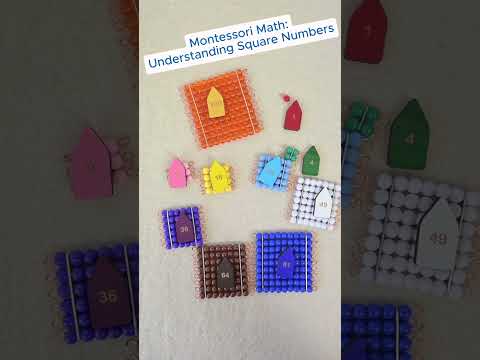
Montessori Short Bead Chains are a powerful hands-on material that help children understand key math concepts through visual and tactile learning.
- Help children understand and build square numbers, while clearly showing why they are called “square numbers”
- Can be used together with bead squares to strengthen number sense and visual learning of multiplication
- Support early geometry learning when combined with polygon cards, helping children connect numbers with shapes

Features of Ten Bead Chains
- A visual tool for learning the times tables
- Each chain helps children learn multiplication facts up to 10 or up to 12, depending on the set

Ideally, I recommend starting with Short Bead Chains before moving on to Ten Bead Chains.
If you only have one child using these materials, you can also choose to “extend” the Short Bead Chains into Ten Bead Chains. In this way, the child can benefit from both materials and develop a deeper understanding of multiplication through gradual progression.